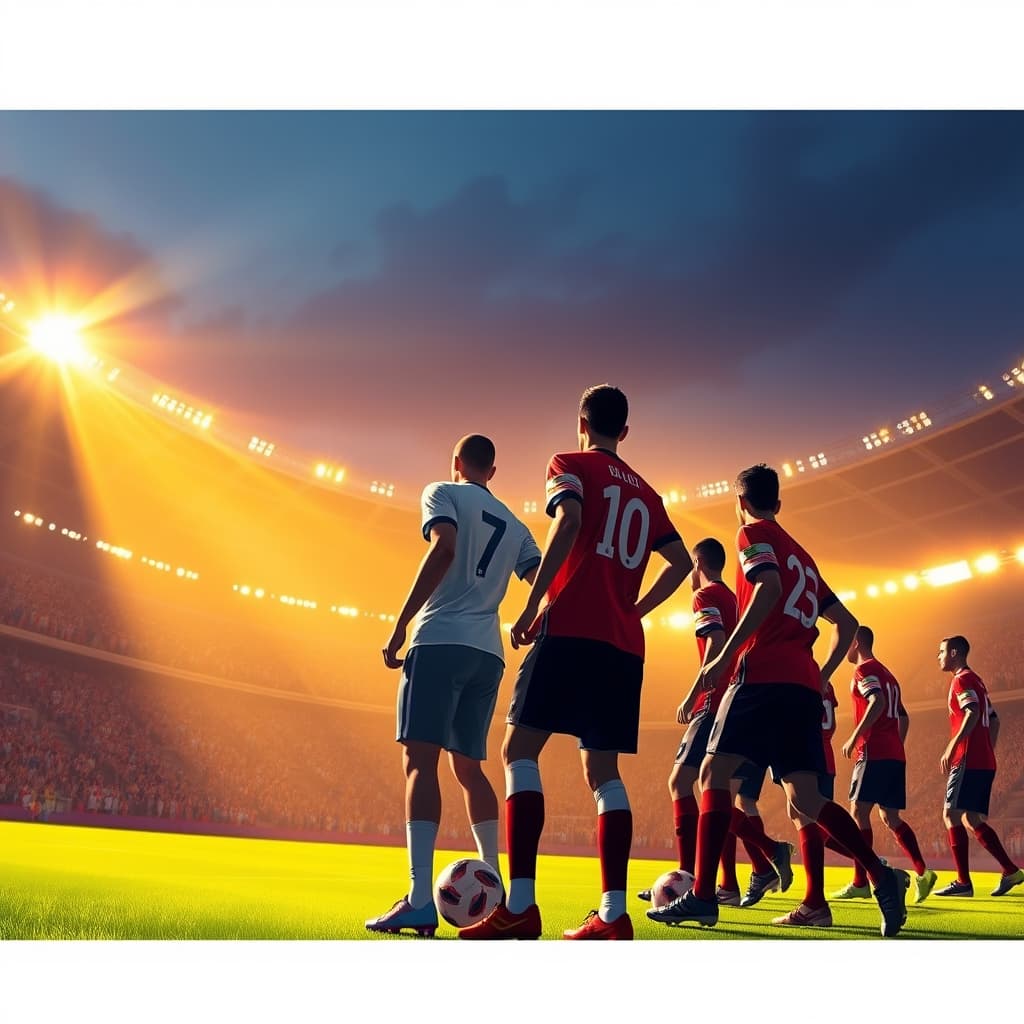
The 2026 World Cup has already produced enough drama to fill a forensic audit, but none of it has exposed FIFA’s frailties quite like the Folarin Balogun red-card saga. What began as a routine disciplinary decision in Bosnia’s group-stage clash with the USA has spiralled into a transatlantic political storm, a European Parliament investigation and a public clash between FIFA’s leadership and the White House. The episode is less about a single refereeing call than about the credibility of football’s global regulator when the stakes are highest.
A red card, a tweet and a transatlantic standoff
The incident itself is straightforward: on Monday night, the USA faced Belgium needing a win to progress, only to see their attacking talisman Folarin Balogun sent off by Brazilian referee Raphael Claus for a second bookable offence in the 67th minute ESPN. The decision, confirmed by FIFA’s disciplinary body, was controversial enough to prompt immediate reaction from the White House’s World Cup taskforce. Andrew Giuliani, head of the taskforce, labelled the referee’s actions “very, very highly suspicious” and invoked an old conspiracy theory about Claus’s refereeing history, referencing a 2024 Brazilian senate inquiry into referee assignments that did not accuse Claus of wrongdoing The Guardian.
That intervention was swiftly followed by former US President Donald Trump, who claimed on social media that Claus was “a little bit suspect” and suggested the decision was biased. The remarks were amplified by Giuliani, who told reporters the referee’s performance raised “serious questions” about the integrity of the match ESPN. The White House’s decision to wade into a refereeing decision—however politically expedient for Trump—has reframed the controversy from a sporting dispute into a geopolitical spectacle.
EU lawmakers circle FIFA’s top brass
The political escalation has now reached the corridors of the European Parliament. Dozens of MEPs are gathering support for a formal investigation into FIFA president Gianni Infantino over his involvement in lifting Balogun’s suspension ahead of the USA’s crunch match with Belgium ESPN. The move is understood to be driven by concerns that political interference—specifically from the US—may have influenced FIFA’s decision-making process. The investigation would scrutinise whether Infantino’s office acted improperly in granting the USA a reprieve, and whether FIFA’s disciplinary protocols were circumvented in the process.
This is not the first time Infantino has faced scrutiny over governance. His tenure has been marked by repeated allegations of opacity in decision-making, particularly around World Cup bidding processes and commercial partnerships. The Balogun case, however, crystallises a growing perception that FIFA’s independence is under threat from external political pressure, whether from the White House, national federations or corporate interests. The fact that the investigation is being pursued at EU level—rather than confined to the USA—signals that the episode is now a matter of global football governance, not just a US domestic issue.
Why FIFA’s disciplinary system is the real casualty
At the heart of the controversy lies FIFA’s disciplinary apparatus, which has repeatedly struggled to maintain consistency and transparency. The Balogun case is the latest in a series of high-profile refereeing decisions that have sparked outrage, from contentious penalty awards to red cards that appear to defy the laws of the game. The problem is not just the decisions themselves, but the opacity of the process that follows them. FIFA’s disciplinary committee operates behind closed doors, with little public explanation for its rulings. This opacity fuels conspiracy theories and erodes trust in the competition’s fairness.
The situation is compounded by the fact that FIFA’s own rules on player eligibility and suspensions are frequently reinterpreted in real time. Balogun’s suspension was lifted on appeal, but the reasoning behind the decision was never fully disclosed. That lack of clarity is damaging in an era where every refereeing call is dissected on social media within minutes. When a decision as visible as a red card can be overturned without a clear explanation, it invites accusations of favouritism or political interference.
The USA’s World Cup exit: collateral damage in a wider storm
The immediate consequence of the red card and subsequent suspension was the USA’s elimination from the tournament. The Americans arrived in North America as one of the pre-tournament favourites, buoyed by home advantage and a talented squad. Their exit at the group stage has already prompted soul-searching about player mentality, tactical naivety and coaching decisions. But the Balogun controversy has overshadowed those debates, shifting focus to the structural issues that undermine the integrity of the competition.
ESPN’s analysis of the USMNT’s failure placed much of the blame on the players themselves, arguing that the squad’s expensive talent failed to deliver when it mattered most ESPN. That critique, however, misses the broader point: if the competition’s disciplinary system is perceived as flawed, then no amount of individual talent can restore faith in the tournament’s fairness. The USA’s exit, while disappointing for their fans, is now inextricably linked to a governance crisis that threatens to define the 2026 World Cup long after the final whistle.
## What it means: a legitimacy crisis for FIFA
The Balogun red-card saga is symptomatic of a deeper malaise at FIFA. The organisation has spent years attempting to rehabilitate its image after the corruption scandals of the 2010s, but its credibility remains fragile. The decision to allow political actors—whether from the White House or the European Parliament—to intervene in refereeing decisions is a dangerous precedent. Football’s global regulator cannot afford to become a plaything for geopolitical interests, yet that is precisely what appears to be happening.
The case also exposes FIFA’s inability to communicate transparently. When a referee’s decision is overturned without a clear explanation, it invites speculation about ulterior motives. FIFA’s disciplinary processes must be opened to greater scrutiny, with independent oversight and public reasoning for major decisions. Without this, the organisation risks becoming a laughing stock—a regulator that cannot regulate itself.
For the 2026 World Cup, the fallout from this episode could linger long after the tournament ends. If fans and pundits begin to question every refereeing decision, every suspension and every appeal, the competition’s credibility will suffer. Football’s global appeal depends on the perception of fairness, and right now, FIFA is failing that test.
## What's next
The immediate next steps will play out on two fronts: politically and within FIFA’s corridors. In Brussels, the European Parliament’s investigation is expected to gather pace, with MEPs demanding access to FIFA’s internal communications and disciplinary files. The outcome could range from a symbolic rebuke of Infantino to a more serious censure that forces structural reforms.
Within FIFA, the organisation may attempt to tighten its disciplinary protocols to prevent future controversies. A push for greater transparency—perhaps through public summaries of major decisions—could be one way to rebuild trust. But FIFA’s history suggests that meaningful reform is unlikely without sustained external pressure.
For the USA, the focus will shift to rebuilding a team that promised so much but delivered so little. The Balogun case, however, means their World Cup will be remembered for more than just their exit. It will be remembered as the tournament where FIFA’s governance crisis became impossible to ignore.
Sources
ESPN: [EU lawmakers eye investigating FIFA's Infantino
The Guardian: [White House’s World Cup head defends Trump lobbying Fifa over red card
ESPN: [USMNT’s failure exposes deeper problems beyond coaching
Watch
https://twitter.com/ChristinaUnkel/status/2073825366704087128